

Myth-busting: Four truths about university vs. college biotechnology programs
Once upon a time, people blamed “bad air” for cholera outbreaks. It took a real step back from conventional wisdom when physician John Snow (no, not Ned Stark’s son) mapped cholera cases in London and pinpointed a contaminated water pump as the source of the epidemic.
The lesson? Sometimes you have to challenge your long-held assumptions to find the real answer. When biology major Lucy H. sat through lectures with 400 of her closest peers in university, she realized her own “hypotheses” about postsecondary education could use examining. By stripping her beliefs that “university opens more doors,” “college labs are less in-depth,” and “employers want degrees” down to the fundamentals, Lucy rebuilt her educational path. What she discovered were four surprising myths about studying biotechnology at a college vs. a university.
Myth 1: University gives more in-depth scientific knowledge.
Reality: University and college programs are designed for different outcomes. University often leans toward a broad theoretical depth and pathways to advanced research or further educational degrees. Mohawk College’s Biotechnology – Advanced program, on the other hand, dives deep into core sciences with a hands-on, practical focus, giving students the tools they'll need to get started in their career.
Lucy learned this firsthand.
“In university, my labs were mostly limited to chemistry. Here, I’ve done so many different labs. It’s not just learning theory. You actually get to practice it.”
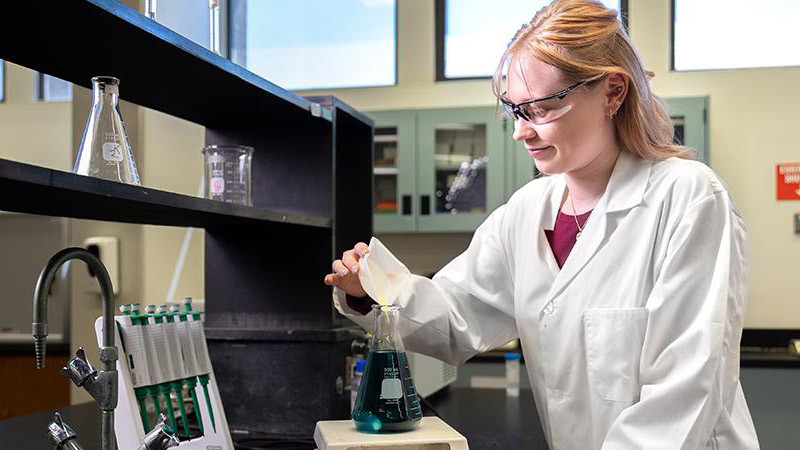
She came in expecting a lighter workload in a college environment. What she discovered surprised her: a collaborative, hands-on lab setting that was just as demanding but had a different focus than her past university program.
Myth 2: A biotechnology degree opens more doors.
Reality: Experience opens doors. Mohawk’s program offers a mandatory co-op component, meaning you get to work in real labs, apply your skills, and build a network before graduating.
“When I saw the co-op option at Mohawk, that sealed it for me,” Lucy explains. “It’s one thing to learn something in class. But I wanted to see how it all works in the real world.”
She realized the value of building connections early. A degree doesn't guarantee a job.
But, if down the road you find you do want a degree, Mohawk has pathways to university programs where your diploma credits can be applied toward further education.
Myth 3: Employers only value bachelor’s degrees.
Reality: Employers value people who can do the work. Mohawk’s four co-op semesters give students up to 16 months of real-world lab experience, often earning an average of $19.30/hour during placements. That’s not just learning, it’s proving yourself in the field.
“I feel more prepared going into the workforce now,” Lucy says. “The labs here gave me real skills I can talk about in interviews. It’s not just theory anymore.”
And the stats back it up: six months after graduation, college and university grads have comparable employment rates in biotech fields.
Myth 4: I’ll be backtracking if I go back to college.
Reality: Every year, thousands of university grads make the pivot to college, realizing what they need is real-world experience, not just credentials.
In Ontario, over 25% of college students already have a degree. They’re not backtracking, they’re recalibrating. “My friend has a bachelor’s and chose to come to Mohawk after,” Lucy shares. “She’s doing great. Honestly, I look up to her for making that move.”
Read more on the Future ready blog.
** Correction: In an earlier draft of this story we incorrectly referred to the masks doctors wore during plague outbreaks when discussing cholera outbreaks. While people blamed the cholera outbreaks on bad air (miasma), there is no truth to the connection to plague doctors and using herbs, etc., in their masks in response to cholera - this "PPE" strategy was in response to the Plague.